
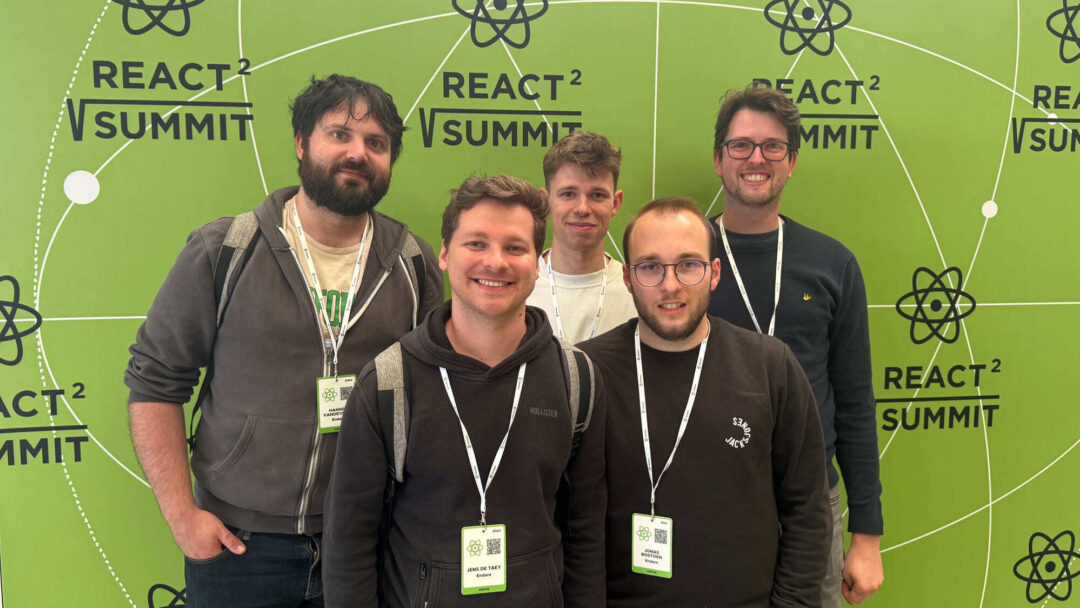
From Amsterdam with Code: 5 Developers' take on React Summit

Hannes Vandevelde
Thursday 18 June 2026
What happens when you send five React and React Native developers to Amsterdam for Europe’s biggest React conference? You get a day packed with groundbreaking tech, inspiring analogies, a lot of AI talk and against all statistical odds: a brand-new Lego set.
Last week, the Endare team headed to React Summit to sync up with the global community, explore the future of the ecosystem, and meet the faces behind the tools we use daily (including the teams at Expo, Firebase, Sentry, and Zed).
Here are our collective highlights and biggest takeaways from a jam-packed day.
The AI Takeover (and why we still have jobs)
If there was a game every time "AI" was mentioned during the conference, we wouldn't have made it back home. But beyond the buzzwords, the actual insights were incredibly grounding.
Craftsmanship in the Age of Automation
The opening talk, The Evolution of App Development by Kadi Kraman of Expo, hit home. Kadi made a brilliant analogy comparing AI tools to the invention of the photo camera. When cameras first arrived, people thought traditional painters were obsolete - anyone could now capture a perfect image instantly, right?
But as we know, anyone can take a picture, but not everyone can make a great picture. Lighting, composition and storytelling still require an expert eye. Similarly, AI can help a newbie spin up an app in minutes, but it won't magically make it robust, performant, or scalable. True development still requires the expert hand of an engineer.
The Shift from Syntax to Architecture
This sentiment was echoed by Adrian Hajdin of JavaScript Mastery. Known for his legendary coding tutorials, Adrian explained how his approach to teaching has had to evolve. We are moving away from teaching syntax, for loops, and while conditions. Instead, the focus is shifting toward software architecture, systems analysis, and creative problem-solving. We aren't just coders anymore; we are architects managing AI-driven workflows.
Deep Diving into the React Ecosystem
As developers, we came for the tech, and the mid-day tracks did not disappoint.
TanStack Start and React Server Components (RSC)
Manuel Schiller, a core contributor, gave us a masterclass on TanStack Start: a new full-stack React framework powered by TanStack Router.
While most React Server Component implementations can feel like a rigid, server-owned tree, TanStack Start treats RSCs purely as data. They become server-rendered fragments that the client can easily fetch, cache, and compose into its own UI. Because it integrates flawlessly with TanStack Router’s built-in cache and TanStack Query, you don't need a separate caching model just for components. It’s a total game-changer for fine-grained invalidation.
React Compiler: Goodbye useMemo?
Mark Erikson of Replay demystified the new React Compiler. For us React devs, understanding how the UI rerenders wasn't new, but the way we handle it is changing. Instead of developers manually sprinkling useMemo and useCallback everywhere to prevent cascading rerenders, this new build-time tool automatically optimizes the code for us. It understands the "Rules of React" natively, works best with React 19 (but supports 17 and 18), and requires zero code rewrites.
Testing Made Fun and The Local-First Future
Making Testing Enjoyable
After lunch, we attended what was surprisingly the most entertaining talk of the day. Younes Jaaidi, a self-proclaimed "Software Cook who enjoys whipping code until tests pass," managed to turn the traditional bane of every developer's existence into a hilarious, motivational session. He introduced us to Vitest and confidently explained why legacy tools like Jest, Jasmine, and Karma belong in the history books.
Peer-to-Peer and Local-First State
We closed out the tracks with Mikkel Malmberg’s talk: P2P React: Local-First State, Shared Truth. Most modern apps treat the central server as the absolute source of truth. Peer-to-peer flips this script: state starts locally on the user's device, and a shared truth emerges without routing every single interaction through a costly central backend.
Using his chat app, Keet, as an example, Mikkel explained how peers can agree on event ordering and independently verify state. We loved the breakdown of the trade-offs involved, especially regarding data availability, permissions and conflict resolution.
Leaving with Full Minds (and Lego!)
To wrap up the day, we headed to the traditional sponsor raffles. While the odds of winning those flashy tech prizes are usually next to zero, the gacha gods smiled upon Endare this year: one of our colleagues actually walked away with a Lego Chess set!
A massive thank you to GitNation for organizing such a seamless and inspiring event, and of course, a huge shoutout to Endare for investing in our growth and letting us geek out on a workday!
Now, back to the keyboard because it's time to build.
Book a meeting
Discuss your idea directly with one of our experts. Pick a slot that fits your schedule!
Keep reading

One protocol. Every major AI vendor. Now what?
Every few months, a new acronym sweeps through enterprise AI conversations and lands on every executive's desk. This year it's MCP.

Thomas Van Duüren

AI should be the last layer you add
Many organisations start their digital roadmap with the same question: “What can we do with AI?” We believe this is the wrong starting point. Not because AI isn’t valuable but because AI is a multiplier, not a fix.
Thomas Van Duüren

Why most AI demos don’t scale
Every AI demo works perfectly. It has a smooth interface, fast responses, seamless and predictable outcomes. But what happens after the demo?
Thomas Van Duüren
